
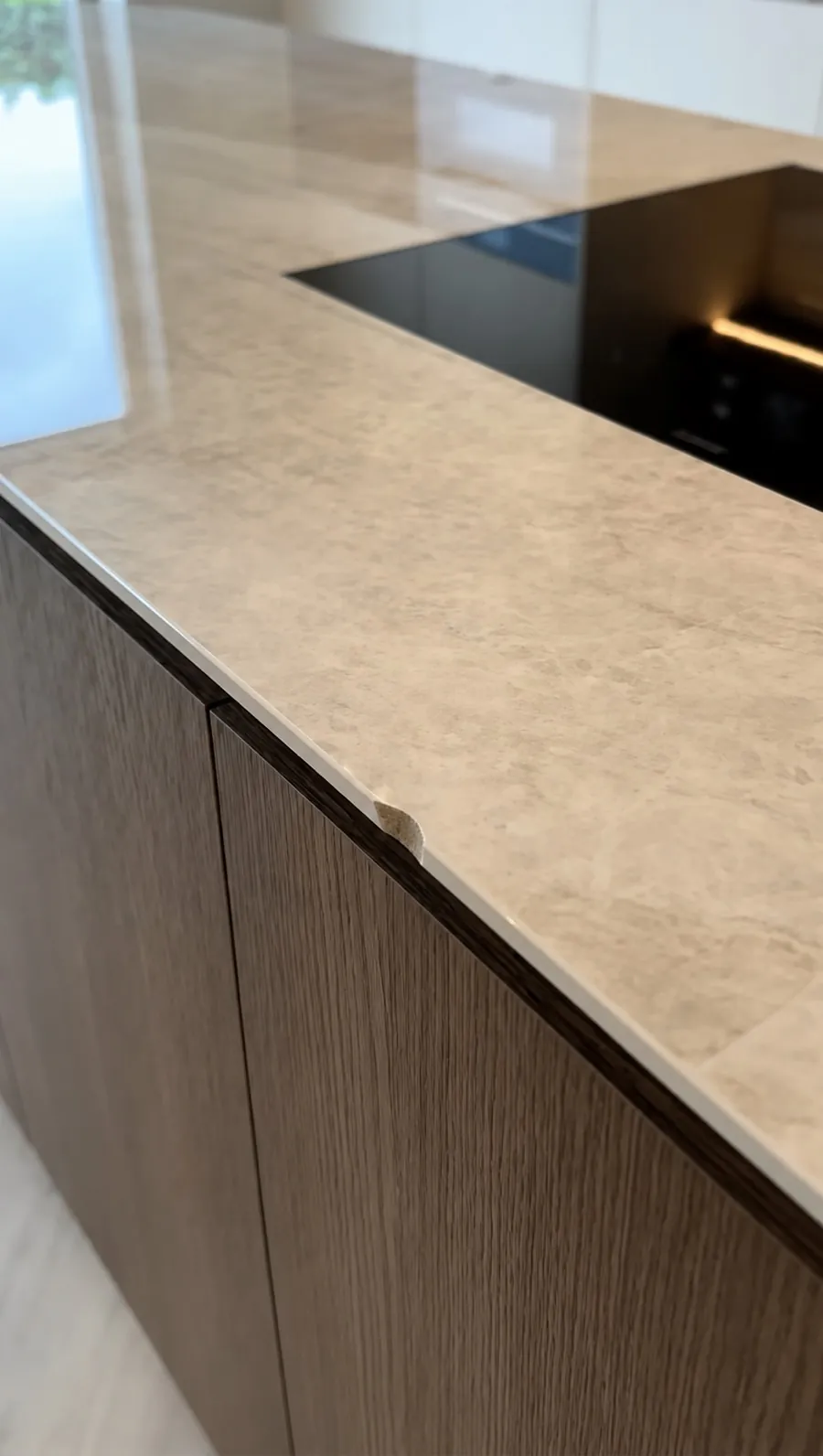
Most people find us after a chip on the edge of the benchtop. They have searched online, found a few videos and a lot of ads, and asked at a hardware store. Nobody gave them a straight answer. Here it is: a chipped stone benchtop can be repaired, on site, in one visit, in most cases. We do this every week as part of our stone benchtop repair in Sydney.
Which stone benchtops can be repaired?
All of the common ones. We repair chips in engineered stone, quartz, marble, granite, limestone and porcelain benchtops. The method changes a little with the material, but the idea is the same. We fill the missing piece, shape it to the edge and make it look like the stone around it.
The most common chip we see is on the front edge, near the sink or the dishwasher. A pot or a plate hits the edge and a piece the size of a fingernail breaks away. The second most common chip is on a corner, from a knock during a move or a renovation.
How we repair a chip in stone
Here is what happens on site.
- We clean the chip and check that the stone around it is solid.
- We mix a filler made for stone and colour it to match the base colour of your benchtop.
- We fill the chip and shape it to the edge profile. On a bullnose or a bevelled edge we copy the curve.
- We let the filler cure, then sand it flush with the surface.
- We paint the pattern back across the repair. On marble and veined engineered stone that means drawing the vein through the filled area.
- We polish the repair to the same sheen as the rest of the top.
Most chips take one visit. We tell you in the quote when you can use the benchtop again.
What makes a chip harder to hide?
Some repairs are easier than others. We tell you which one you have before you decide.
| Chip | How the repair looks |
|---|---|
| Small edge chip on a plain or speckled stone | Very hard to find once polished |
| Chip on a heavy vein | Good. We draw the vein through it. Look closely and you may see it |
| Large corner missing | Good. The rebuilt corner is shaped by hand and matched |
| Chip on a polished black stone | Harder. Black shows every change in sheen, so we polish more |
| Chip that has been filled with glue or epoxy | Harder. We have to remove the old fill first |
The last one is common. A chip that has been filled with a hardware store epoxy is more work than a fresh chip. The epoxy yellows, it sits proud of the surface and it does not take colour. We grind it out and start again.
What to do until we arrive
A chip does not get worse on its own. The stone is not going to crack from the chip. You do not need to do anything, and it is better if you do not.
- Do not fill it with glue, epoxy or nail polish. It makes the repair harder and it shows.
- Do not sand or scrub the edge. You will dull the polish around the chip.
- Keep the chipped edge clean and dry.
- Take a photo of the chip with a coin next to it for scale, and one from further back.
Send us those two photos and we will send you a fixed written quote within one business day.
When we say the benchtop should be replaced
We repair chips. We also tell you when a repair is the wrong answer.
- The benchtop is cracked right through and the two sides are moving. A crack like that needs support under the top, or a new top.
- The stone has been cut short or fitted wrong. That is a stone mason job.
- The whole top is worn, scratched and dull. One chip is a repair. A whole top is a re-polish or a replacement.
None of these is a chip. If you have a chip, you almost certainly have a repair.
What a repair saves you
Replacing a stone benchtop means a template, a new slab, cutting, delivery, a plumber to disconnect and reconnect the sink, and a fitter. It also means a slab that may not match the splashback. A repair fixes the chip and leaves everything else where it is. We quote each chip from a photo so you can compare the two before you decide.