
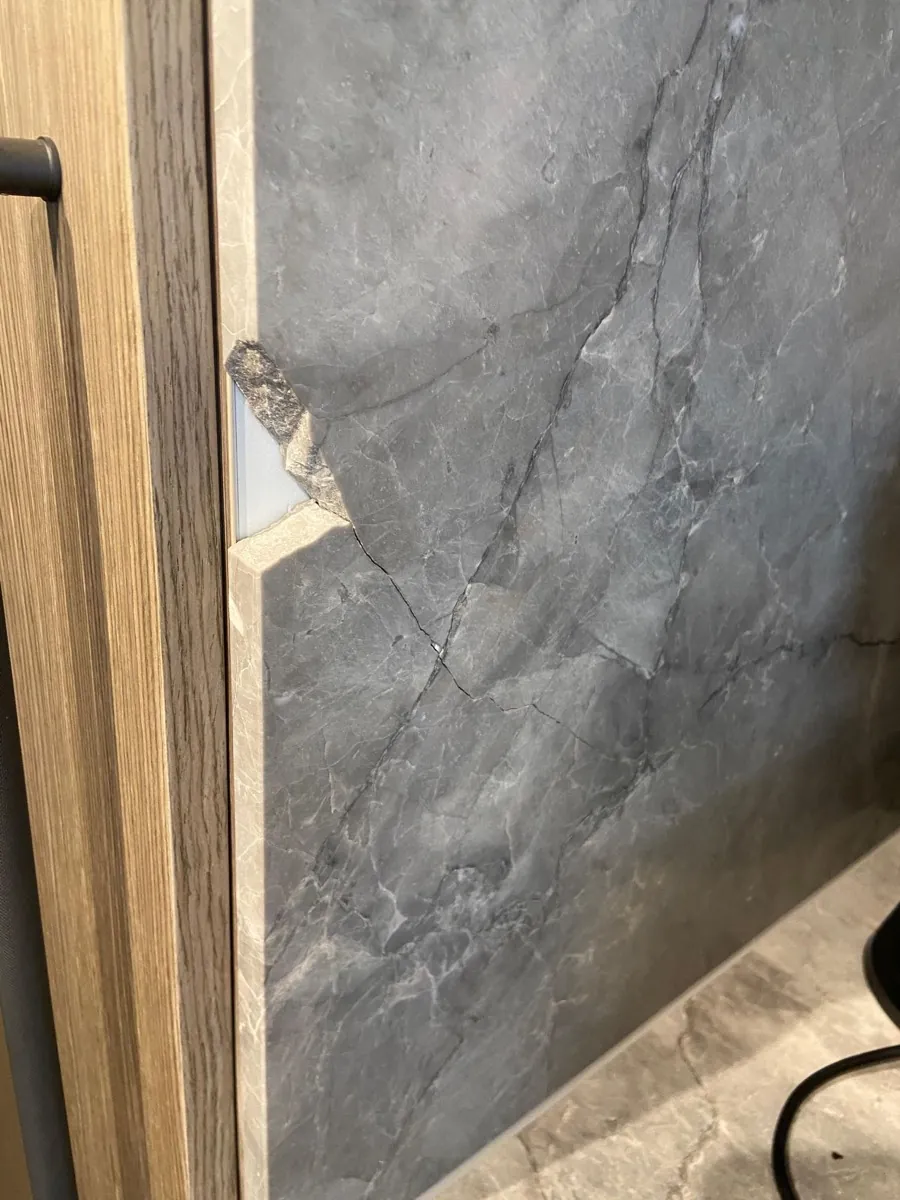
There is a wall of repair kits at every hardware store. Epoxy, filler sticks, touch-up pens, wax crayons. Some people buy one and then do not open it, because they are worried about making it worse. That worry is sensible. This is what a kit can do, what it cannot, and how we fix the ones that went wrong on our stone benchtop and laminate benchtop jobs in Sydney.
What a kit can do
Be fair to the kits. There are jobs they handle.
- A small scratch on a plain, matt surface, in a spot nobody looks at closely. A wax stick or a touch-up pen can dull it down.
- A white line on the edge of a dark laminate. A touch-up pen makes it less obvious.
- A pin hole from an old screw on a painted surface, filled and painted with the original paint.
The common thread is plain colour, matt finish and low stakes.
What a kit cannot do
A repair has to match three things. The colour, the pattern and the sheen. A kit does none of them well.
Colour. Kits come in a handful of colours. Your benchtop is not one of them. Even "white" is a dozen different whites once it has aged under your kitchen light. We mix colour on site, against the surface.
Pattern. A vein, a speckle or a wood grain has to be painted back across the fill by hand. A kit gives you a flat blob in the middle of the pattern.
Sheen. A gloss benchtop needs the fill polished to the same gloss. A satin door needs a satin finish. Epoxy dries to its own sheen, which is glassy, and it does not sand and polish like stone.
Shape. An edge chip needs the edge profile rebuilt. A bullnose has to curve, a pencil edge has to be straight. Epoxy slumps or sits proud as it cures, and you cannot shape it once it is hard.
What goes wrong with epoxy
We see the same things again and again.
- It yellows. Clear epoxy goes yellow in sunlight within months. On a white benchtop the chip is now a yellow spot.
- It sits proud, or sinks. Epoxy shrinks as it cures, or it is left high. Either way you can feel it and see it at a low angle.
- It stains the edges. Epoxy wicks into the pores of stone and laminate board around the chip. When we remove it, the stained edge has to come out too, so the repair is bigger than the original chip.
- It cracks out. Epoxy that is not bonded properly pops out when the edge is knocked again, taking a bit more of the surface with it.
- It still shows. The chip is filled, and it is still a chip. Now it is a shiny one.
Fixing a DIY repair
Yes, it can be fixed. We grind the old fill out, clean the edges back to sound material, and repair the chip the way we would have from the start. The repair takes longer and ends up a little bigger than the original chip, because the epoxy has to come out without damaging the stone or the laminate around it.
If you have already used a kit and it looks bad, do not try to remove it yourself. Scraping and sanding around a chip dulls the polish, and now there are two problems.
A quick test before you open the kit
Ask yourself three questions.
- Is the damage on an edge, a corner or a cut-out? Kits cannot rebuild an edge.
- Is the surface patterned, glossy or dark? Kits cannot match any of those.
- Would you notice a slightly wrong colour every time you walk past? If yes, the kit will bother you.
If any answer is yes, take a photo of the damage with a coin next to it and one from further back, and send it to us. We reply with a fixed written quote within one business day and tell you plainly whether it is a kit job or a repair job. Sometimes it is a kit job. We will say so.