
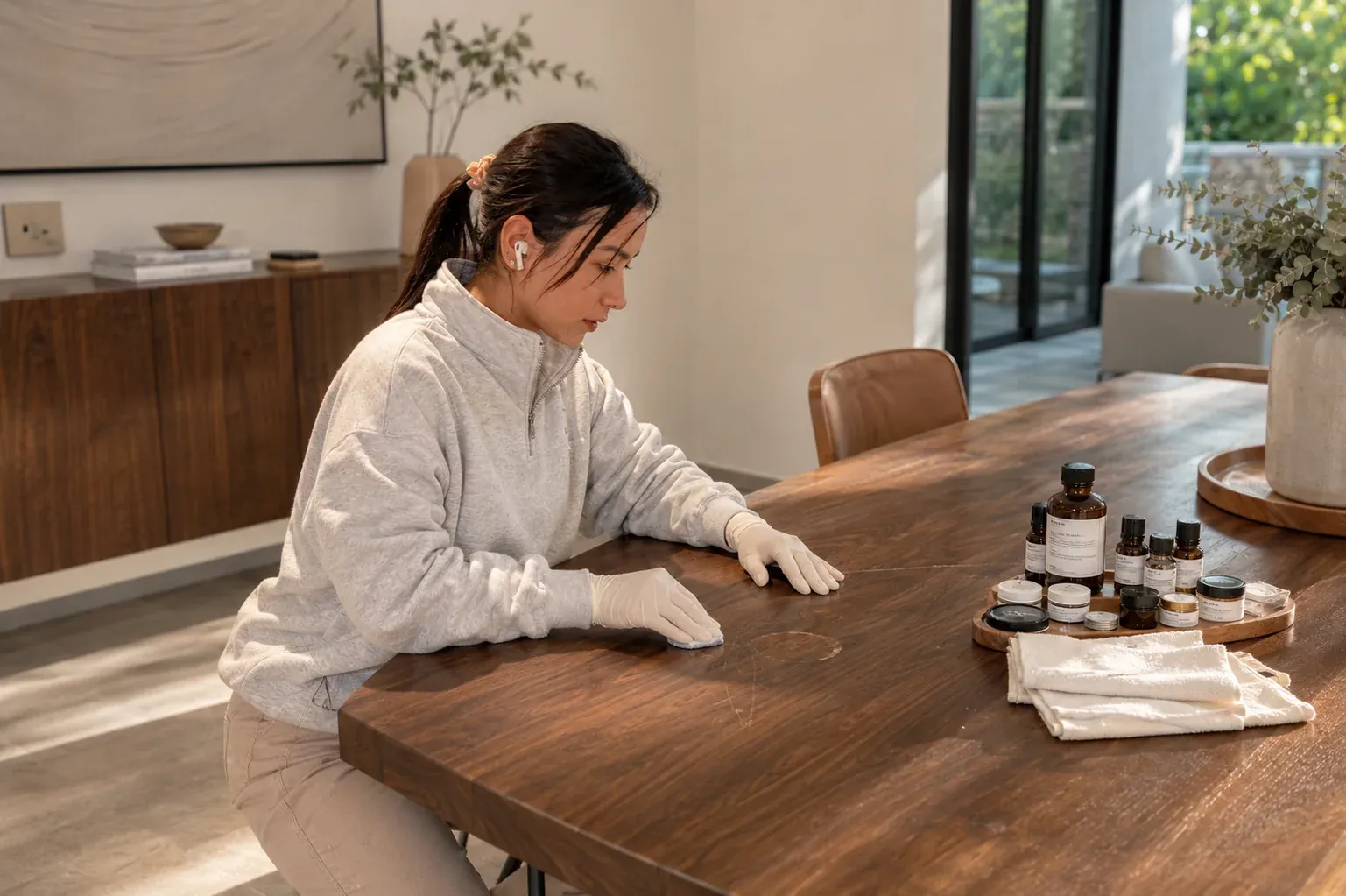
A hot dish left on the table, a glass with no coaster, a spray cleaner that seemed harmless, a bottle of nail polish remover. Timber tables collect marks, and most of them can be repaired without taking the table anywhere. This is what we see on our timber furniture repairs and French polishing jobs in Sydney, and what we can do about each one.
White rings and heat marks
A white or cloudy ring is the most common mark on a table. It comes from a hot dish, a hot mug or a cold wet glass. The heat or the moisture gets into the finish and turns it cloudy. The timber underneath is fine.
We lift the mark out of the finish and blend the spot back in. If the finish has cracked or bubbled, we cut that area back and rebuild the finish over it. Either way, it is repaired where the table stands.
Do not rub it with toothpaste, mayonnaise or a hot iron. The internet suggests all three. They work sometimes and they ruin the finish the rest of the time.
Dark rings and water marks
A dark ring means the water went through the finish and into the timber. The timber has stained. This takes more work than a white ring. We treat the stain, colour the timber back to match the grain around it and rebuild the finish over the spot. It can be done in your home.
A dark ring on a veneer table is the hardest case, because veneer is thin and we cannot sand deep. We tell you what to expect from a photo.
Scratches, scuffs and gouges
Light scratches are in the finish. We cut them back and re-finish the area so they stop catching the light. Deep scratches and gouges are in the timber. We fill them, colour match the fill to the grain and re-finish the area. The repair is matched to the sheen of the rest of the top.
Scratches across a whole table top, from years of use, are a re-finish rather than a repair. We do that too, in your home, with French polish or a harder finish depending on how the table is used.
Spray cleaner and silicone polish damage
Many spray cleaners and furniture polishes contain silicone or ammonia. Over time they leave a smeary, streaky surface that no amount of wiping fixes, and some soften the finish. On French polish, a strong cleaner can strip the shellac in one go.
We remove the residue, cut the finish back to sound material and rebuild it. Afterwards, the care is simple. A soft, slightly damp cloth, then a dry one. Nothing else.
Nail polish and nail polish remover
Nail polish remover dissolves most finishes on contact. The mark is a bare or softened patch, often with a ring around it. Nail polish itself sits on top and takes some finish with it when it is picked off.
We cut the patch back to sound finish, colour the timber if it has changed, and rebuild the finish so it matches the top. On a French polished table the repair blends in especially well, because shellac can be re-polished into itself.
What can be fixed at home and what cannot
| Mark | Repaired in your home? |
|---|---|
| White ring or heat mark | Yes |
| Dark water ring | Yes, more work than a white ring |
| Scratches and scuffs in the finish | Yes |
| Gouges and dents in the timber | Yes |
| Cleaner residue and softened finish | Yes |
| Nail polish and remover marks | Yes |
| Worn finish across the whole top | Yes, as a re-finish over more than one visit |
| Broken joints, loose legs, split boards | No. That is a cabinet maker job. We finish the piece after |
What to do before we come
- Stop using spray cleaners and polishes on the table.
- Do not sand the mark. On veneer you can go through in seconds.
- Do not try the iron or hairdryer method on a shellac finish.
- Take a photo of the mark in daylight, with a coin for scale, and one of the whole table.
Send us the photos and we reply with a fixed written quote within one business day. If the table is worth a full French polish, we tell you that too, and why.